Opening scene
Demographics
Mariana is thirty-three years old and lives in a seventy-square-metre apartment in Almada, on the south bank of the Tagus across from Lisbon. She works part-time as an administrative assistant at a small accounting firm, earning roughly nine hundred euros a month. Her husband Ricardo is an electrician whose income fluctuates with seasonal demand. Together they manage, but there is rarely anything left over after rent, groceries, childcare, and the car payment. They have two children — Tomás, five, and Beatriz, three. Mariana finished a polytechnic course in office management but never completed her degree. She speaks Portuguese natively and functional English from school and Netflix subtitles. She identifies as lower-middle class and is quietly aware of every euro that leaves their account.
Living situation
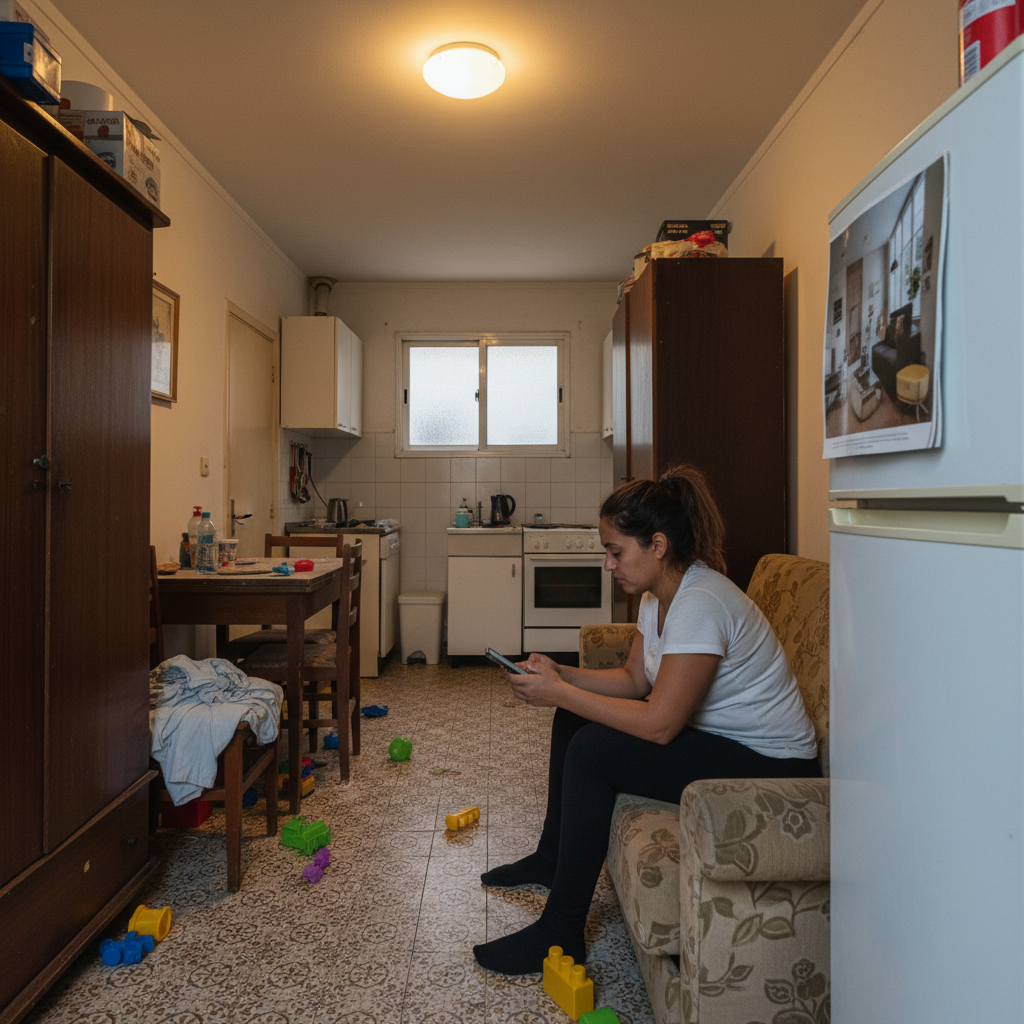
The apartment is a T2 in a 1990s-era building with small rooms, tiled floors throughout, and windows that face a concrete courtyard. The living room doubles as a play area. Most of the furniture was inherited or given by relatives — a dark wood dining table from Ricardo's parents, a bookshelf from Mariana's childhood bedroom, the sofa from her mother-in-law. Nothing matches, but everything is functional. The kitchen is narrow and dated. Mariana has tried small changes — a cushion cover from Primark, a plant from IKEA — but they feel like drops in an ocean. Storage is the constant battle: toys migrate into every room, shoes pile by the door, and the hallway cupboard is so full that opening it requires courage. She dreams of a calm, pretty space but cannot imagine how to get there without gutting the flat entirely.
Psychographics
Mariana carries a quiet, persistent shame about her home that she rarely names aloud. She believes beautiful homes belong to people with money, taste, or both — and she has neither, by her own harsh reckoning. She values warmth, family, and practicality, but aesthetics feel like a luxury reserved for others. When she sees interior design content online, her first reaction is aspiration quickly followed by deflation. She is resourceful and organised at work but feels overwhelmed domestically, where the sheer volume of stuff and the smallness of the space defeat her. She distrusts anything that feels elitist or performative. She responds to warmth, directness, and evidence that someone understands real constraints — financial, spatial, emotional.
Behavioural patterns
Mariana's digital life happens almost entirely on her phone, mostly after the children are in bed. She scrolls Instagram and Pinterest in Portuguese and English, saving posts she likes but never acting on them. She has never visited an interior design website intentionally — she encounters design content through the algorithm, mixed in with parenting tips and recipe videos. When she does land on a design service page, she typically leaves within seconds if she sees prices above one hundred euros, professional photography that looks nothing like her reality, or language that assumes a certain lifestyle. She shops at IKEA, Primark Home, and occasionally Leroy Merlin. She reads product reviews carefully and is sensitive to shipping costs. She would never book a consultation without first telling her husband, not because she needs permission but because any discretionary spend is a joint decision. She trusts word-of-mouth and would be more likely to act on a recommendation from a friend or a relatable social media post than on an advertisement.
Contextual influences
Portuguese housing culture means many families live in apartments they rent or bought with heavy mortgages, and interior upgrades are often postponed indefinitely. There is a cultural norm of receiving furniture from family — refusing it would be rude, so homes accumulate pieces that do not belong together. The cost of living in greater Lisbon has risen sharply, and Mariana feels this daily. Her social circle includes other young mothers in similar situations; none of them would consider hiring an interior designer. The idea itself would provoke gentle mockery — that is something for rich people or television. Sara's pricing might genuinely be accessible, but Mariana would need to see explicit proof, ideally in a context that mirrors her own life.
Response patterns & biases
Mariana's default response to any design service is exclusion: this is not for me. She filters through a lens of affordability first, relatability second. If the website leads with aspirational imagery — white walls, designer furniture, curated stillness — she will bounce immediately, confirming her belief that interior design is a world apart. She is susceptible to the authority bias of professional branding: polished design paradoxically makes her trust the expertise but distrust the accessibility. She responds strongly to social proof from people who look like her — real homes, real budgets, real mess. She is loss-averse and would need reassurance that spending fifty euros would not be wasted money. She tends to overthink decisions and defer to her husband as a way of sharing the risk of being wrong.
Pain points
Brand relationships
Mariana shops at IKEA for small items but finds the experience overwhelming and often leaves with things she did not plan to buy. She follows Portuguese home accounts on Instagram — Lar Doce Lar and similar — but views them as entertainment, not instruction. She has a complicated relationship with aspiration: she wants it but resents how it makes her feel. She has no relationship with any design service brand and would describe interior designers as people who work with rich clients.
Daily life
Mornings are a rush of school runs, breakfast battles, and the twenty-minute ferry commute to her office in Lisbon. Afternoons are childcare logistics. Evenings are cooking, tidying, bedtime routines, and then collapse. Her personal time is the hour between the children's bedtime and her own, spent on the sofa with her phone. Weekends revolve around family visits, the supermarket, and occasionally a trip to the park or the shopping centre in Almada Forum.
Backstory
Mariana grew up in a modest flat in Setúbal, the daughter of a factory worker and a school canteen assistant. Her childhood home was clean but never decorated — function was everything. She met Ricardo at eighteen, they married at twenty-five, and Tomás arrived two years later. The apartment in Almada was the best they could afford, and she was proud of it initially. But after six years, two children, and the slow accumulation of other people's furniture, she feels the flat has become something she endures rather than enjoys. She once tore a page from a magazine — a simple, bright living room — and stuck it on the fridge. It is still there, curling at the edges.
Mariana does not need convincing that her home matters — she already feels its weight every day. What she needs is someone to look at her seventy square metres of hand-me-downs and say, with genuine conviction, that there is something worth working with here.