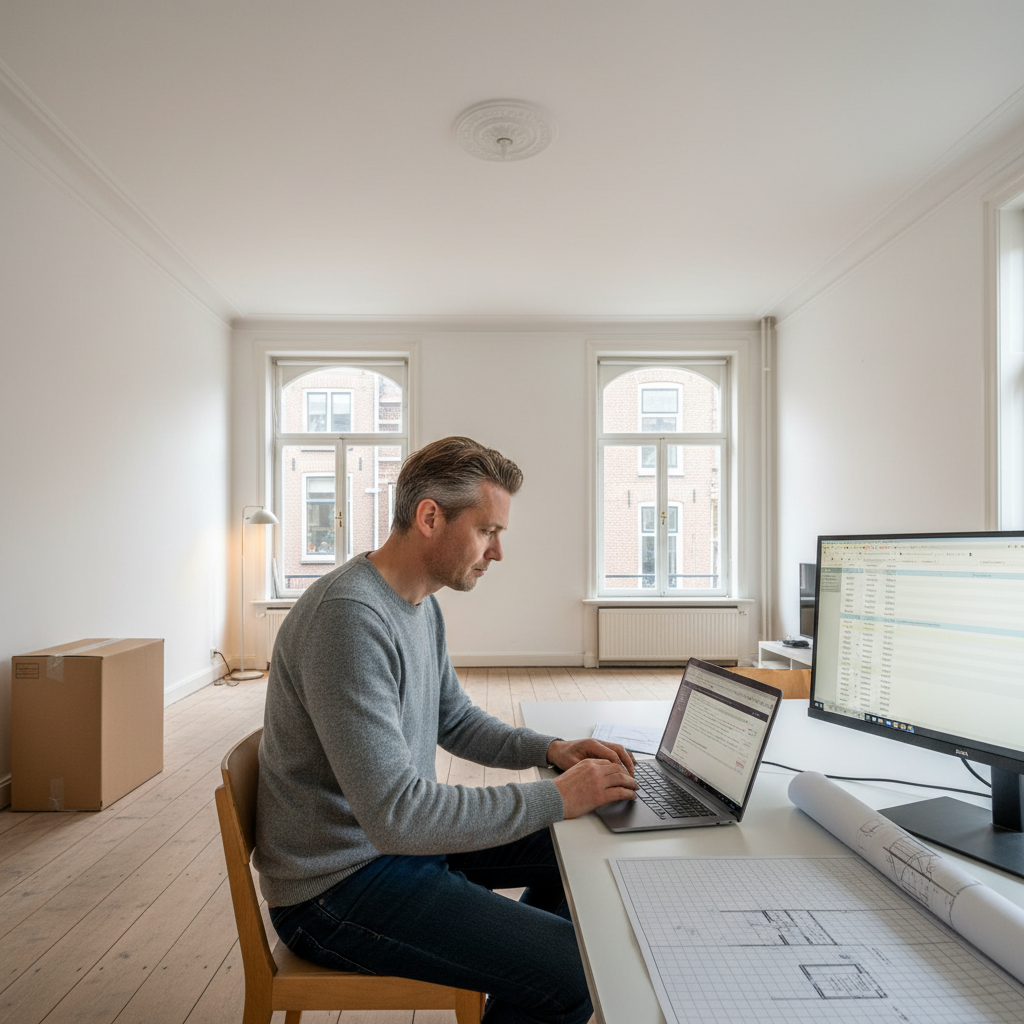
Opening scene
Demographics
Daan is forty-one years old, born and raised in Amersfoort, and now living in Amsterdam-Oost after a decade of renting in various Dutch cities. He works as a project manager at a mid-sized tech company in the Zuidas, earning a comfortable salary that allowed him — with considerable financial stretching — to buy his first apartment earlier this year. He is single, university-educated, and speaks Dutch and English fluently. He is the kind of person who researches a purchase thoroughly, reads every review, and still feels uncertain. His friends would describe him as competent and organised at work but oddly paralysed when it comes to personal decisions that involve taste rather than logic.
Living situation
The apartment is eighty-five square metres in a 1930s-era building in Amsterdam-Oost, with high ceilings, wooden floors, and an awkward L-shaped living room that defeats every furniture layout he has attempted. The kitchen was recently renovated by the previous owner. The bedroom is adequate. There is a small study nook. The flat has good bones, as people say, but Daan does not know what to do with bones. Currently, the living room contains the temporary dining table, two chairs, a floor lamp, and a stack of cardboard boxes he has not yet recycled. The bedroom has a mattress on a bed frame and a wardrobe. The walls are bare. He tells visitors he is still settling in. He has been saying this for four months.
Psychographics
Daan suffers from what might be called aesthetic insecurity — a deep uncertainty about his own taste that is disproportionate to his general competence. He can manage complex technical projects with dozens of stakeholders, but choosing a sofa colour fills him with existential doubt. He fears making an expensive mistake that he will have to live with for years. He associates interior design with a knowledge he was never taught — a visual literacy that other people seem to possess naturally. He values quality and is willing to spend reasonably, but he needs rational justification for every purchase. He is drawn to minimal, clean aesthetics but worries that his preference is merely a default born of not knowing what else to like.
Behavioural patterns
Daan researches obsessively. He has visited the websites of Made.com, Hay, IKEA, Flinders, and numerous smaller Dutch design shops. He has a Pinterest board he would never show anyone. He has watched YouTube apartment tours and read blog posts about Scandinavian versus japandi versus mid-century modern until the words lost meaning. He has not bought a single major piece of furniture beyond the temporary table and the bed frame. His decision-making process follows a pattern: research, narrow down, doubt, research more, compare, doubt again, close all tabs, start over next weekend. He has considered hiring an interior designer but assumed the cost would be several thousand euros — he once saw a quote for five thousand on a Dutch design firm's website and mentally filed all designers under that price bracket. He would respond well to a clear, bounded service with a fixed price and a defined outcome.
Contextual influences
Dutch housing culture places enormous weight on the home as personal expression — gezelligheid is a cultural value, and bare walls are noticed. Daan feels social pressure to have a finished, inviting apartment, especially as a homeowner in his forties. His colleagues and friends have homes that look considered and complete. Amsterdam-Oost has a specific aesthetic: a mix of vintage finds, design pieces, and plants that looks effortless but is carefully curated. Daan is aware of this standard and feels he is falling short. The Dutch directness around money means he would appreciate transparent pricing — hidden costs or vague quotes would trigger immediate distrust. He is also accustomed to efficient, well-structured services and would judge ELI's website partly on its professionalism and clarity.
Response patterns & biases
Daan's primary bias is anchoring: his reference price for interior design is the five-thousand-euro quote he once saw, and anything lower will seem surprisingly affordable — if he gets far enough to see it. His secondary bias is analysis paralysis, which a structured service could resolve rather than exacerbate. He responds well to frameworks, step-by-step processes, and deliverables he can evaluate. Testimonials from men or from people who describe similar indecision would resonate strongly. He is sceptical of anything that feels fluffy or emotional — he wants competence, structure, and a clear return on investment. A sixty-minute session with a concrete plan would appeal to his project-manager brain, but only if the website explains exactly what he will receive.
Pain points
Brand relationships
Daan respects Hay and Muuto as aspirational but has not purchased from them. He has a functional relationship with IKEA — useful for basics but not for the apartment he wants to create. He follows design accounts on Instagram passively and has bookmarked several pieces on Flinders. He has no relationship with any design service and would approach one the way he approaches any professional service: evaluating credentials, reading reviews, and comparing options before committing.
Daily life
Daan cycles to work in the Zuidas, spends his days in meetings and project boards, and returns to his mostly empty apartment around half past six. He cooks simple meals, exercises three times a week at a gym near Oosterpark, and spends evenings reading, watching series, or falling down furniture-research rabbit holes. Weekends involve cycling, meeting friends for coffee or borrels, and intermittent bursts of apartment-related research that end in no decisions. He is comfortable and content in most areas of his life, which makes the apartment paralysis all the more frustrating.
Backstory
Daan grew up in a tidy but unremarkable family home in Amersfoort — his parents were practical people who bought furniture from Leen Bakker and never redecorated. He never developed a design vocabulary or visual confidence. Throughout his twenties and thirties, he rented furnished or semi-furnished apartments where the decisions were made for him. Buying his own place was a milestone he had worked toward for years, and the weight of permanence — of choosing things that would define his home for a decade — has frozen him. He joked to a friend that he could plan a product launch for fifty people but could not pick a rug. The friend did not laugh, because it was obviously true.
Daan does not lack budget or willingness — he lacks confidence and a framework for making decisions he cannot optimise with data. If ELI's website can show him that a structured, affordable process exists, he will book within the week.