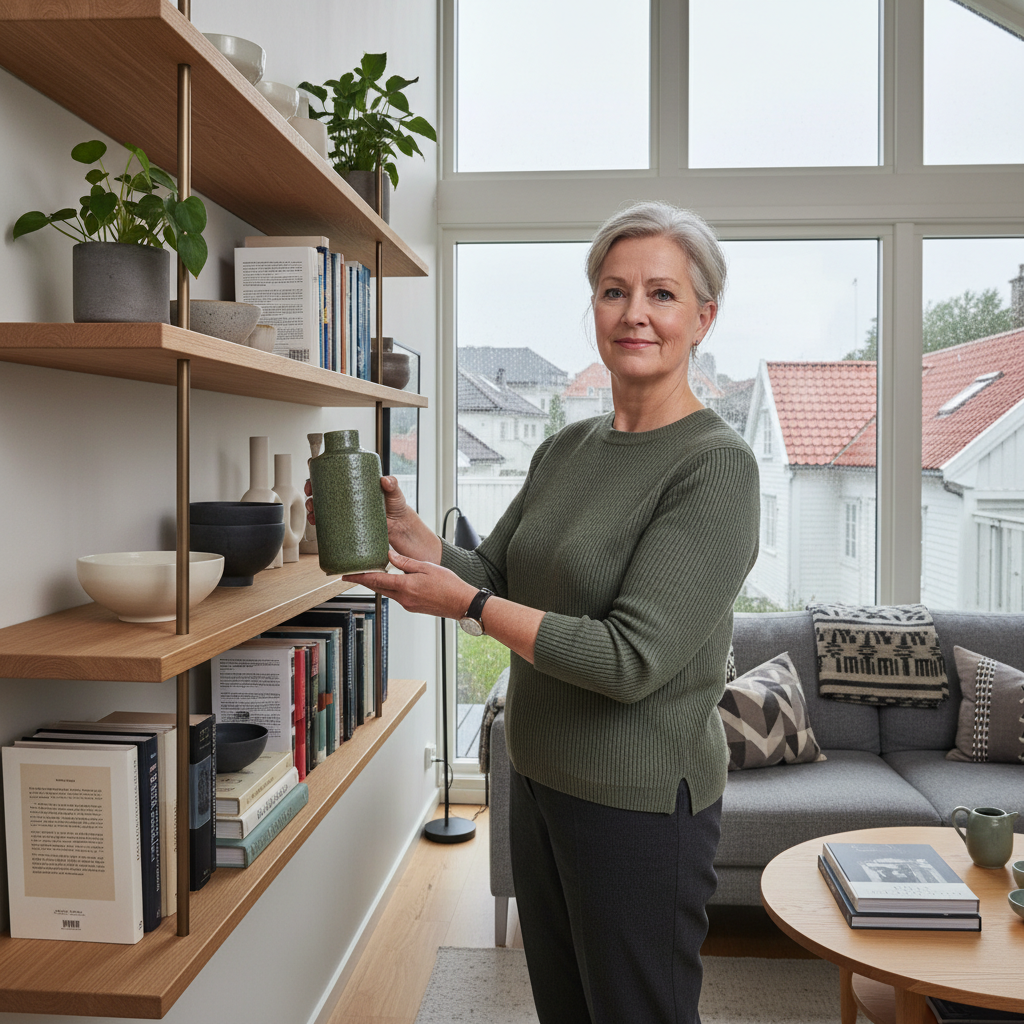
Opening scene
Demographics
Ingrid is fifty-eight years old and lives in a detached wooden house in a residential neighbourhood south of Bergen city centre. She retired two years ago from her position as a school librarian, a role she held for twenty-six years. Her pension, combined with her husband Geir's income as a semi-retired marine engineer, provides a comfortable life without extravagance. Their two children are grown — one in Oslo, one in Trondheim — and visit several times a year. Ingrid speaks Norwegian and reads English fluently, having spent a year in Scotland during university. She is well-read, opinionated, and takes quiet pride in her competence across many domestic domains, from cooking to gardening to interiors.
Living situation
The house is a traditional Bergen timber home, roughly one hundred and twenty square metres across two floors, with a small garden. Ingrid and Geir bought it twenty-three years ago and have renovated it gradually over time — new kitchen eight years ago, bathroom five years before that, fresh paint every few years. Ingrid has furnished and decorated the entire house herself, drawing on Scandinavian design principles she absorbed through magazines, museum visits, and a lifetime of paying attention. The interiors are tasteful, calm, and coherent: a mix of vintage Norwegian pieces, IKEA basics, and a few investment items from Hay and Muuto. She knows where every object came from and why it is there. The house is her proudest creative project, and she maintains it with the same care she once applied to her library collection.
Psychographics
Ingrid's identity is partly built on her domestic competence. She sees her ability to create a beautiful home without professional help as evidence of resourcefulness, good taste, and self-sufficiency — virtues she values highly. She is quietly dismissive of people who hire designers for ordinary homes, viewing it as either laziness or a lack of confidence. She enjoys design content as a hobby but engages with it from a position of authority, not need. She is warm with friends and family but can be cutting about what she perceives as unnecessary spending or outsourced thinking. She does not realise that her confidence, which is genuine, can shade into a snobbery that would make others feel small.
Behavioural patterns
Ingrid follows several Scandinavian design accounts on Instagram and reads Bo Bedre and Rum magazine regularly. She visits design shops and museums for pleasure and keeps a mental catalogue of trends she approves of and those she does not. She has never visited the website of a design service with any intention of booking — her visits, if they happen, would be motivated by curiosity or the desire to evaluate and compare her own taste against a professional's. She is the kind of person who would browse ELI's portfolio not as a potential client but as a peer reviewer. If the website impressed her, she might grudgingly respect it. If it did not, she would feel validated in her scepticism. She occasionally recommends design ideas to friends and family, positioning herself as a knowledgeable resource. She has never considered that someone might offer a service she would benefit from.
Contextual influences
Norwegian design culture is deeply embedded in everyday life — good taste is considered a civic virtue, and most Norwegians engage with their homes as expressions of identity. The concept of hiring a designer for a standard home is less normalised than in some countries; the DIY ethos is strong, and there is cultural pride in self-sufficiency. Bergen itself has a particular aesthetic sensibility shaped by its weather, its wooden architecture, and its university-town culture. Ingrid exists within a social milieu of educated, capable women who decorate their own homes competently and would view hiring a designer as an admission of inadequacy. This cultural context makes her a challenging audience — not because she cannot afford ELI or does not appreciate design, but because she does not believe she needs it.
Response patterns & biases
Ingrid's dominant bias is the Dunning-Kruger adjacency of genuine competence: she is good at this, which makes her assume she cannot get better and that others should be equally capable. She evaluates design services through a critical, comparative lens rather than a need-based one. She would notice inconsistencies between ELI's stated philosophy and its execution — if the website says accessible but looks exclusive, she would spot the contradiction immediately. She responds to intellectual substance, design knowledge, and credentials. Flattery or emotional appeals would fail. The only message that might reach her is one that acknowledges existing competence and offers something beyond it — a fresh perspective, a second opinion, a refinement of what is already good. She would never respond to messaging that implies she is doing something wrong.
Pain points
Brand relationships
Ingrid has strong, informed opinions about design brands. She respects Hay, Muuto, and Fritz Hansen as quality Scandinavian producers. She uses IKEA selectively and without shame — she views the ability to mix high and low as a sign of real taste. She subscribes to Bo Bedre and follows curated Norwegian design accounts. She has no relationship with any design service brand and would approach one with the evaluative confidence of someone who considers herself an equal.
Daily life
Ingrid's days have a gentle, self-directed rhythm. She walks along the fjord most mornings, tends her garden when the weather allows, reads extensively, and meets friends for coffee at least twice a week. She volunteers at the local library one afternoon a week. She cooks elaborate meals and hosts dinner parties where the table setting is always considered. Home maintenance and decoration are ongoing pleasures, not chores. She and Geir travel to Copenhagen or Stockholm once or twice a year, always visiting design shops and museums.
Backstory
Ingrid grew up in a small town near Stavanger, the daughter of a teacher and a carpenter. Her father built their furniture, and her mother sewed curtains and cushions — the idea that a home should be made, not bought, was instilled early. She studied literature at the University of Bergen, worked briefly in publishing, and then found her calling as a school librarian. She married Geir at twenty-nine, and furnishing their first flat together was one of the happiest projects of her life. Over the decades, she has refined her taste, learned from mistakes, and developed a quiet expertise that her friends and family genuinely admire. She has never had reason to question whether she might benefit from outside perspective.
Ingrid is not ELI's target client, but she is a gatekeeper. If the website earns her respect, she might recommend it to a friend who needs help. If it patronises her, she will dismiss it entirely and take her network's attention with her.