Opening scene
Demographics
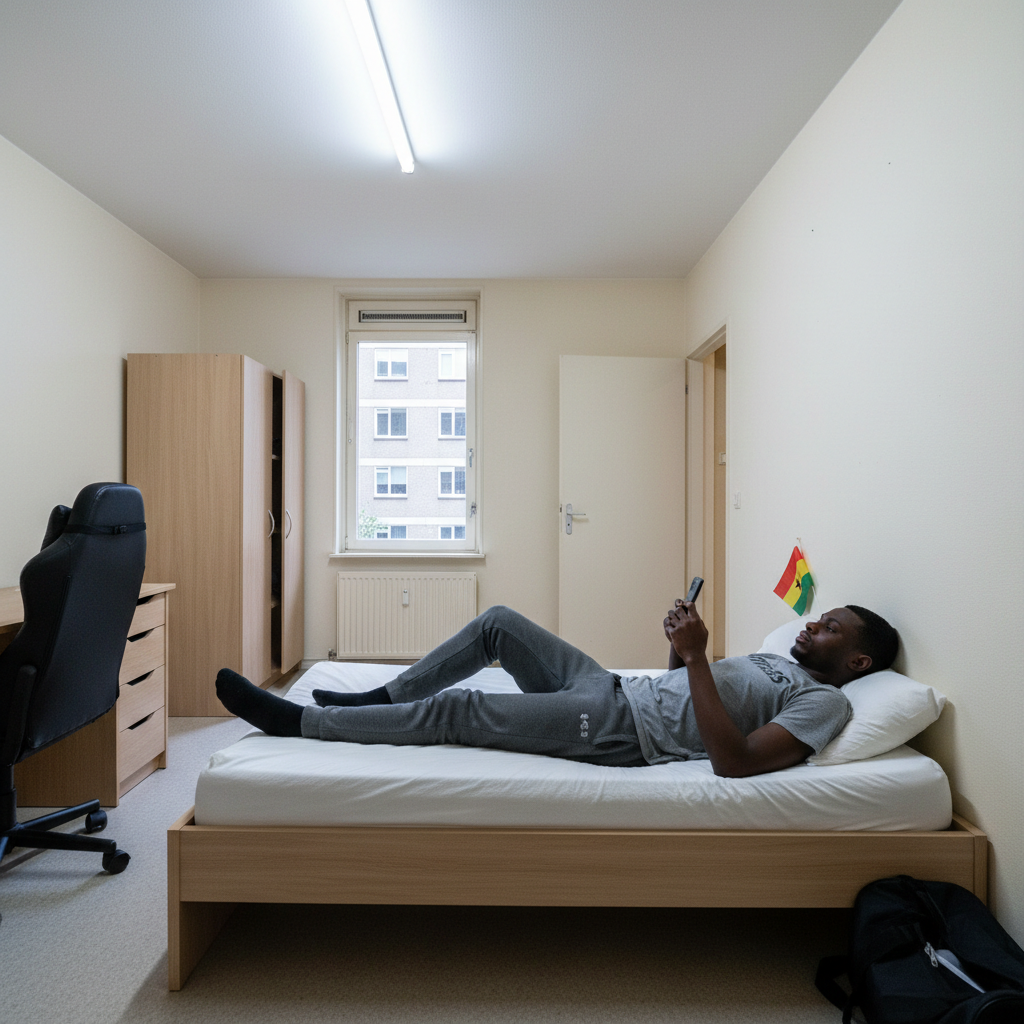
Kwame is twenty-eight years old, born in Rotterdam to Ghanaian parents who immigrated in the late 1990s. He works as a junior logistics coordinator at a distribution company in the Europoort area, earning a modest salary that covers his rent, his gym membership, and a social life centred on going out, football, and occasional trips to visit family in Accra. He completed an MBO-4 qualification in logistics and supply chain management. He speaks Dutch and English fluently and conversational Twi with his parents. He is sociable, physically active, and oriented toward experiences rather than possessions. His room is where he sleeps; his life happens elsewhere.
Living situation
The shared flat is in a 1970s-era apartment block in Rotterdam-West. Kwame rents one room and shares the kitchen, bathroom, and living area with two flatmates — a Dutch IT student and a Polish warehouse worker. The shared spaces are functional but uninspired: mismatched kitchenware, a sofa someone found on Marktplaats, and a television. Kwame's room is roughly fifteen square metres. The IKEA MALM bed, MICKE desk, and MARKUS chair were purchased in a single trip when he moved in, chosen for convenience. The wardrobe stores his clothes and gym bag. There are no decorative objects, no plants, no art. The overhead fluorescent light gives the room a flat, institutional quality. Kwame does not notice this because he has never experienced an alternative.
Psychographics
Kwame is not opposed to the idea of a nice living space — it simply does not register as a priority or even a possibility. His identity is built around social connection, physical fitness, and career progression, not domestic life. He associates interior design with women, wealth, and a life stage he has not yet reached. He is ambitious in a practical, incremental way: he wants a better job, his own flat eventually, maybe a car. The idea of spending money or mental energy on how a room looks strikes him as premature and slightly alien. He is open-minded, however, and not dismissive — if someone he respected showed him a different way of thinking about space, he might be curious. He simply has never encountered that prompt.
Behavioural patterns
Kwame's media consumption is almost entirely on his phone: TikTok, Instagram, YouTube, and WhatsApp groups. He follows fitness influencers, football accounts, Ghanaian music pages, and a few Dutch lifestyle creators. He has never followed a design account or engaged with interior content intentionally. If a room-makeover video appeared in his TikTok feed, he might watch it for entertainment but would not connect it to his own situation. He shops online for clothes and tech but has never browsed a homeware website. His purchases are need-driven: when something breaks, he replaces it with the cheapest functional option. He would not visit ELI's website under any current circumstance — he would only encounter it if a friend shared it, if an ad appeared in his social feed, or if a life change prompted him to think about his space for the first time.
Contextual influences
Rotterdam's young rental population is transient, and many people in Kwame's demographic treat their living spaces as temporary stations. The Dutch rental market, with its scarcity and high costs, reinforces the idea that investing in a rented room is pointless. Among Kwame's social circle — mostly young men of various backgrounds — talking about interior design would feel unusual, even performative. Ghanaian-Dutch culture values hospitality and presentation when hosting, but this applies to the family home, not a young man's rented room. The gender dimension is significant: Kwame unconsciously codes interiors as a feminine concern, a bias reinforced by the media he consumes. For ELI to reach him, it would need to bypass these cultural filters entirely.
Response patterns & biases
Kwame's primary bias is irrelevance filtering: he would not engage with content he perceives as outside his world, and interior design currently sits firmly outside it. He is not hostile — he simply does not see himself in the audience. If he did land on ELI's website, he would likely feel it was not for him within the first few seconds, based on imagery, tone, or the absence of anyone who looks or lives like him. He responds to authenticity, directness, and content that does not take itself too seriously. Humour and visual transformation — before-and-after content showing small rooms made dramatically better with minimal spending — would be the most likely format to capture his attention. He trusts peer recommendations over professional authority.
Pain points
Brand relationships
Kwame's relationship with brands is functional and price-sensitive. IKEA is where you buy furniture; Action is where you buy household basics; Nike and Adidas are the brands he cares about. He has no awareness of design brands, homeware brands, or design services. His brand loyalty exists in fitness, fashion, and technology — domains where he has developed taste and opinions. Interiors is a blank space.
Daily life
Kwame wakes early for his shift, which starts at seven. He cycles to work in Europoort, spends the day coordinating shipments, and finishes around four. He goes to the gym three or four evenings a week, plays football on Saturdays with a mixed-background group of friends, and goes out in Rotterdam on Friday or Saturday nights. Sundays he might visit his parents in Rotterdam-Zuid, where his mother cooks Ghanaian food and his father watches football. His room is where he sleeps and scrolls his phone — rarely where he spends conscious, waking time by choice.
Backstory
Kwame is the middle child of three, raised in Rotterdam-Zuid by parents who worked long hours — his father in construction, his mother as a cleaner and later a care assistant. The family home was tidy and functional, furnished practically, with the living room reserved for guests and special occasions. Kwame shared a bedroom with his younger brother until he moved out at twenty-four. He has never had a space that was truly his own in any designed sense — his room is simply the first place where nobody else sleeps. The idea that it could be something more has genuinely never occurred to him, not because he rejected it but because nobody and nothing in his life has ever suggested it.
Kwame represents the audience that does not yet know it is an audience. ELI cannot convert him today, but a single piece of content — the right video, the right before-and-after — could plant the seed that a fifteen-square-metre room is worth caring about.