Opening scene
Demographics
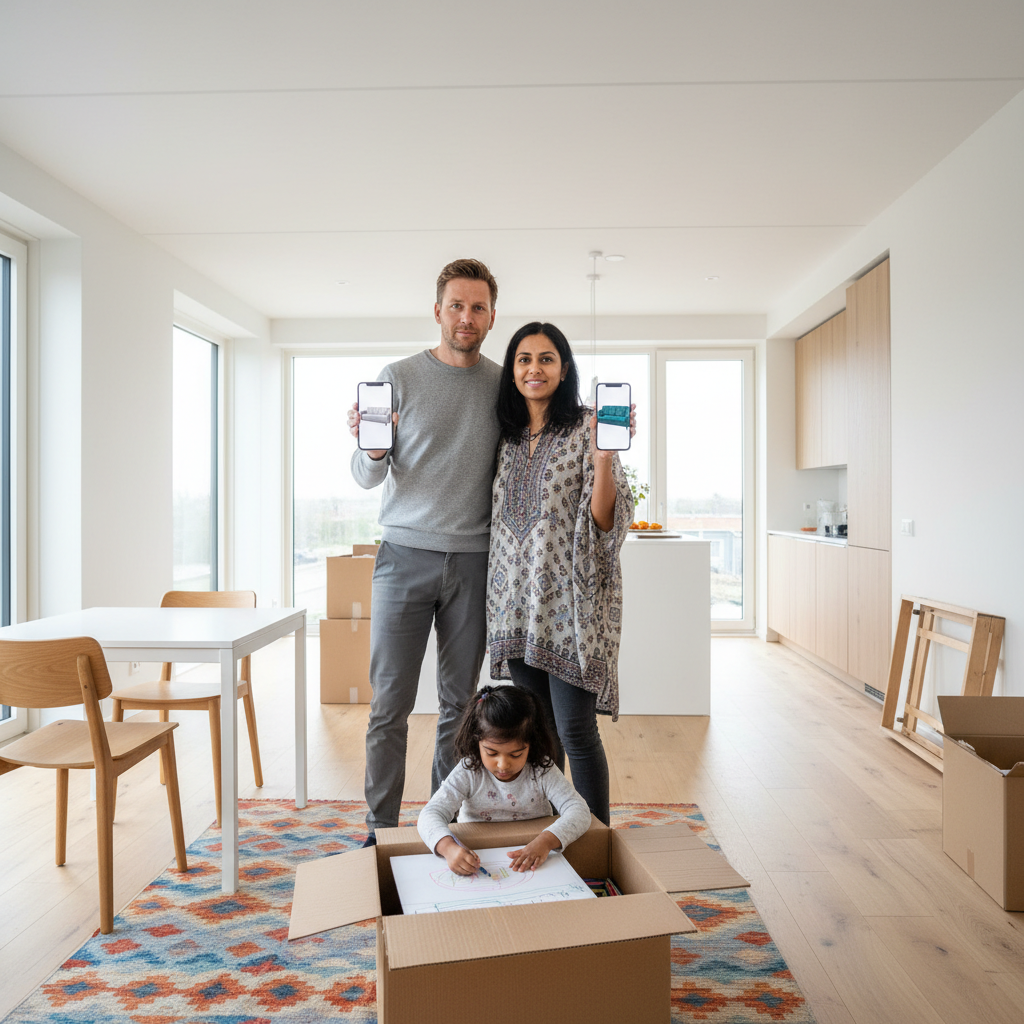
Tom is thirty-seven and Priya is thirty-five. They live in a newbuild apartment in Diemen, approximately ninety square metres, which they purchased two years ago. Tom works as an urban planner for the municipality of Amsterdam, and Priya is a communications manager at a pharmaceutical company in Hoofddorp. Their combined income is comfortable by Dutch standards, allowing for a mortgage, childcare, and moderate discretionary spending. Tom is Dutch, born in Haarlem, and Priya is British-Indian, born in Leicester and raised between the UK and the Netherlands. They met at a university in Delft, married six years ago, and have one daughter. They speak English at home, Dutch with Anika at nursery events, and Priya speaks Hindi with her parents on video calls. They are the kind of couple who agree on values but diverge on surfaces.
Living situation
The apartment is in one of Diemen's newer residential developments: clean lines, large windows, good light, open-plan living and kitchen, two bedrooms and a small study. It was delivered as a blank canvas, which initially excited them and has since become the source of their longest-running domestic disagreement. Anika's room is fully furnished — they agreed on that quickly, because the child's needs provided a clear framework. The rest of the flat is a patchwork: the kitchen has been equipped, the master bedroom has a bed and curtains, and the living room has a dining table (IKEA, intended as temporary), two mismatched chairs, a rug Priya bought that Tom tolerates, and the aforementioned cardboard-box coffee table. The walls are white. The potential is obvious; the progress is glacial.
Psychographics
Tom's aesthetic sensibility is Dutch minimalist: he gravitates toward clean surfaces, neutral tones, functional forms, and negative space. He finds visual clutter physically uncomfortable and associates it with disorder. Priya's aesthetic is warmer and more layered: she wants colour, texture, pattern, soft lighting, and objects that carry cultural or emotional meaning. She grew up in a British-Indian household where the living room was rich with textiles, framed family photographs, and decorative objects from India. Neither of them is wrong, and they know this intellectually, but taste is not intellectual — it is visceral, and their visceral responses pull in opposite directions. They need a mediator who can find the overlap between their worlds, but they have not framed it that way. They think they need a designer. What they actually need is a translator.
Behavioural patterns
Tom and Priya research independently and then attempt to converge, which rarely works. Tom browses Dutch design sites — Flinders, Hay, vtwonen — and saves items that are invariably grey, white, or natural wood. Priya browses Made.com, Anthropologie, and Indian textile shops online, saving items that are invariably colourful, patterned, or ornate. They show each other their finds and the conversation stalls. They have tried compromise — both picking their second-favourite option — but compromise in aesthetics often produces something neither person likes. They have discussed hiring a designer but have not acted on it, partly because of cost assumptions and partly because they cannot agree on what to ask for. If they found ELI's website, one of them would need to discover it first and convince the other. The service description would need to address couple dynamics explicitly, or they would not recognise it as relevant to their specific problem.
Contextual influences
Diemen is Sara's own territory, which creates a local-trust opportunity. The couple lives in the kind of newbuild development that Sara likely knows well — similar floor plans, similar challenges. Mixed-culture households are common in the Amsterdam metropolitan area, and the aesthetic negotiation Tom and Priya face is more typical than they realise. Dutch directness means Tom would want transparent pricing and clear deliverables. British-Indian warmth means Priya would want evidence of emotional intelligence and cultural sensitivity. The fact that they are local could be a significant draw if the website highlights it, or a missed opportunity if it does not. They would both respond to evidence that the designer has worked with couples who disagree — normalising their situation would be more powerful than any portfolio image.
Response patterns & biases
Tom and Priya filter through different lenses simultaneously. Tom evaluates on efficiency, clarity, and value: Is the service well-structured? Is the pricing transparent? Will I get a concrete plan? Priya evaluates on warmth, sensitivity, and aesthetic range: Does this designer understand different cultural contexts? Will she push us toward one style at the expense of the other? Together, their biases create a dual filter that the website must pass: professional enough for Tom, personal enough for Priya. They both suffer from a false-dichotomy bias, believing their styles are irreconcilable when a skilled designer could find genuine common ground. A service that explicitly names design mediation — or acknowledges that couples often disagree — would immediately capture their joint attention.
Pain points
Brand relationships
Tom respects Hay, vtwonen, and the general Dutch design ecosystem. Priya follows Anthropologie, enjoys the maximalist end of Instagram interiors, and occasionally buys textiles from Indian homeware brands online. They overlap at IKEA — both use it pragmatically — and at restaurants and hotels where the design feels considered but not sterile. They have no relationship with any design service brand. If they were to hire someone, the recommendation of a friend or neighbour in Diemen would carry more weight than any website testimonial.
Daily life
Weekday mornings are a choreography of nursery drop-off, two commutes in different directions, and the logistical messaging that holds a dual-career family together. Evenings involve collecting Anika, dinner, bath, bedtime stories, and then the brief adult interlude before their own sleep. Weekends are family-focused: the park, the Amstel, visits to grandparents, and the occasional attempt to shop for furniture that ends in amiable disagreement. They are happy, busy, and slightly exhausted — the apartment is the one project that has been indefinitely deferred because it requires a kind of joint decision-making energy they rarely have left over at the end of the day.
Backstory
Tom and Priya met during a master's programme in Delft, where their differences were charming rather than challenging. Early flats were furnished with whatever was cheap and available, and style disagreements were minor because nothing was permanent. Buying the Diemen apartment changed the stakes: this was their home, their daughter's home, and every choice felt consequential. The first argument about a sofa colour surprised them both — they had navigated cultural differences in parenting, food, holidays, and family expectations with relative grace, but aesthetics turned out to be the domain where their backgrounds diverged most stubbornly. They have joked about it, argued about it, and ultimately parked it. The cardboard-box coffee table has become a family mascot of indecision.
Tom and Priya do not need more options — they need a process. If ELI's website can show them that a designer can hold two competing visions and find the honest overlap, they will book before the cardboard box finally collapses.