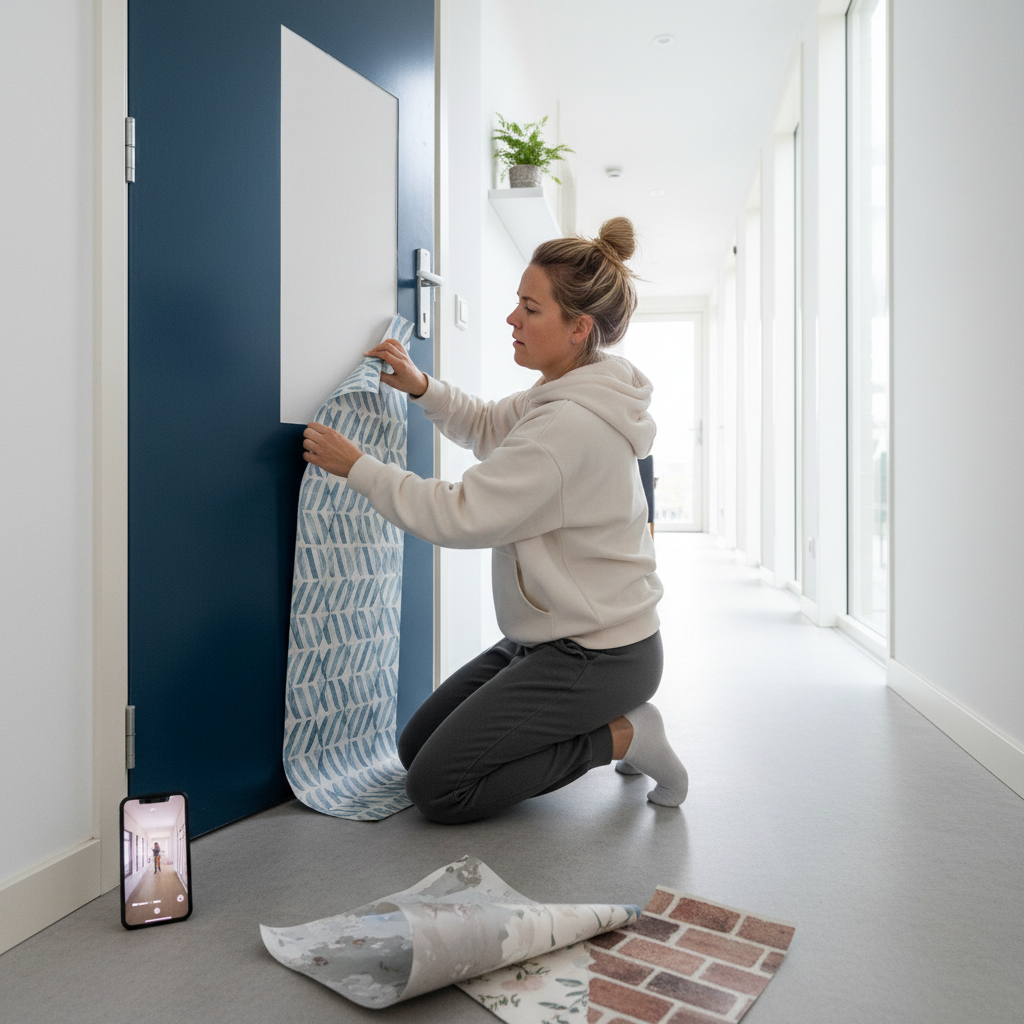
Opening scene
Demographics
Sanne is thirty-one, Dutch, born and raised in Zwolle before studying urban planning at the University of Amsterdam. She works as a junior project manager in the spatial planning department of the Gemeente Amsterdam, a role she secured three years ago after two fixed-term contracts and an unpaid internship she resents in retrospect. She earns roughly thirty-eight thousand euros a year before tax, which in Amsterdam's rental market feels like barely enough. She identifies as cisgender, heterosexual, white Dutch, and carries a quiet awareness that her demographic is a minority in her own building. Her education trained her to see systems — zoning, density, liveability — and she cannot switch that lens off, not even in her own flat.
Living situation
Sanne rents a fifty-five-square-metre one-bedroom apartment on the sixth floor of a Holland Park newbuild, completed in 2021. The lease is through a private landlord who bought off-plan; she pays fourteen hundred and sixty euros a month, which eats close to half her net income. The apartment has floor-to-ceiling windows, good natural light, and the hollow-wall acoustics typical of Dutch mass housing. She lives alone, which she mostly prefers, though the silence on Sunday afternoons can press in. She cannot paint, drill, or alter anything structural — a constraint she works around with adhesive hooks, textile panels, and furniture arranged to hide the landlord's beige curtains she is contractually obliged to keep.
Psychographics
Sanne scores high on openness and conscientiousness, moderate on neuroticism, low on agreeableness, and very low on extraversion. She has strong aesthetic convictions and a near-physical discomfort around visual clutter or poor design — a badly kerned sign can irritate her for the rest of her commute. She processes the world visually first, verbally second. Her values centre on intentionality, sustainability, and anti-consumerism, though she recognises the contradiction in owning forty-three houseplants and a growing collection of secondhand Danish ceramics. She is restless at her core — satisfied neither with her career trajectory nor with the gap between the home she imagines and the one her rental contract permits. Risk-averse with money, adventurous with aesthetics.
Behavioural patterns
Sanne shops slowly and deliberately. She will research a single lamp for three weeks across Marktplaats, Vinted, Loods 5, and Instagram vintage accounts before buying — or deciding against it. She follows roughly two hundred design-adjacent accounts, mostly Dutch and Scandinavian, and her saved-posts folder is essentially a mood board she never consolidates. She browses Funda listings she cannot afford as a form of aspiration and mild self-torture. Her phone screen time averages four hours daily, mostly Instagram, Pinterest, and Reddit's r/interiordesign. She cycles a Swapfiets to Amsterdam-Zuid station and takes the metro to Waterlooplein for work. She cooks simple meals from Albert Heijn, uses Too Good To Go twice a week, and considers Thuisbezorgd a moral failure she commits roughly monthly. Offline, she is quiet — two close friends, a WhatsApp group with university mates she mostly lurks in, and a monthly dinner with her parents in Zwolle. She avoids networking events and finds small talk physically exhausting.
Contextual influences
Sanne belongs to the Dutch millennial cohort that graduated into a functional job market but an impossible housing one. She has watched homeownership recede year by year; her parents bought their Zwolle rijtjeshuis for what she now pays annually in rent. This shapes a low-level financial anxiety she manages by over-controlling what she can — her budget spreadsheet, her meal planning, her flat's aesthetic. Holland Park itself is a strange place to live: architecturally ambitious, demographically young and international, but still lacking a real neighbourhood centre or community texture. She notices this professionally — she could write the planning critique in her sleep — and it feeds her restlessness. She is at the life stage where friends are coupling up and buying, and she is doing neither, which she frames as a choice but sometimes fears is just a circumstance.
Response patterns & biases
In interviews, Sanne is articulate, precise, and slightly guarded. She gives considered mid-length answers rather than effusive ones, and she will correct her own phrasing mid-sentence if it does not feel accurate enough. She has a strong negativity bias toward anything that looks mass-market, generic, or patronising — she will notice and comment on design flaws before acknowledging strengths. She is susceptible to aesthetic halo effects: beautiful presentation will buy a product significant credibility with her before she examines the substance. She dislikes being sold to and will resist overt persuasion, but she responds strongly to restraint, craft cues, and what she perceives as insider-level taste. She may understate interest to avoid seeming easily impressed — a Dutch directness layered over a deeper need to appear discerning.
Pain points
Brand relationships
Sanne is brand-aware but not brand-loyal. She gravitates toward brands that signal taste without shouting — HAY, Muuto, Ikea's collaborations rather than its basics, local ceramicists she finds on Instagram. She distrusts anything that advertises aggressively and respects brands that let their product speak. Price matters enormously, but she will save for months for one object she considers beautiful rather than buy three adequate ones. She shops secondhand by preference and considers it both ethical and aesthetically superior.
Daily life
A typical weekday: alarm at seven, cycle to Diemen-Zuid metro in eight minutes, standing-room commute to Waterlooplein, eight hours of spatial-planning meetings and GIS work she finds meaningful but bureaucratically exhausting. Home by six-fifteen, she changes into joggers, waters the plants that need it, and eats something simple whilst scrolling design content on the sofa. Two evenings a week she rearranges a shelf or experiments with a textile. She is in bed by eleven, reading on her Kobo, asleep before midnight.
Backstory
Sanne grew up in a tidy but unremarkable rijtjeshuis in Zwolle where aesthetics were functional, not aspirational — her mother's idea of decorating was a new set of HEMA cushion covers. University in Amsterdam awakened something: she discovered that spaces could be intentional, that design was a language, that the gap between a room that works and one that sings was knowable. She stayed for the city, took the planning job because it was adjacent to her passion, and found the Holland Park apartment through a colleague's tip. Three years in, she is accomplished at making a rented box feel like hers, but the effort of it — the impermanence, the compromise — is starting to wear. She wants a next step but cannot see one that her salary and the market will permit.
Sanne's relationship with her home is one of devoted, frustrated stewardship — she pours creative energy into a space she does not own and cannot fully shape. A flyer that speaks her visual language would not just catch her eye; it would feel like proof that someone in her neighbourhood understands what she has been looking for.