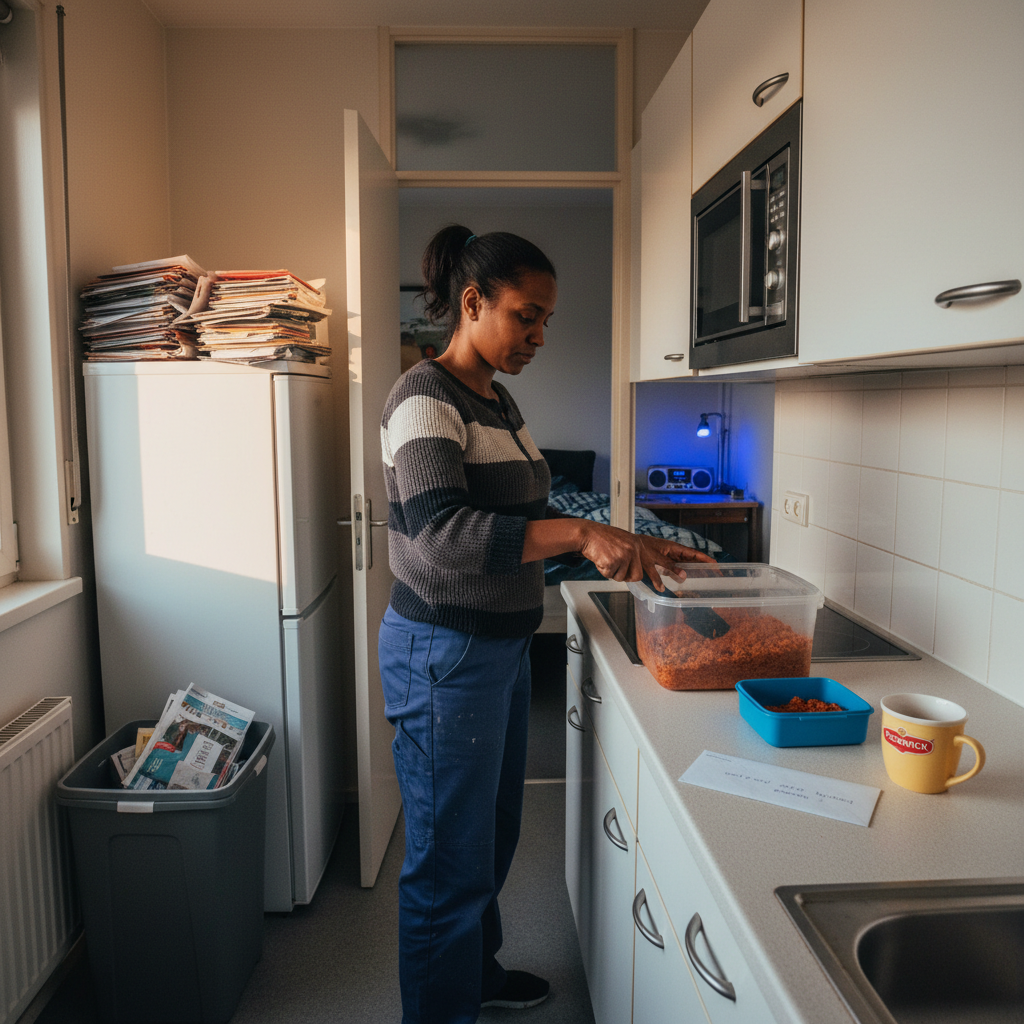
Opening scene
Demographics
Denise is a 44-year-old Surinamese-Dutch woman, born in Paramaribo and raised in Amsterdam-Zuidoost from the age of seven. She completed an MBO-3 qualification in healthcare at ROC Amsterdam and has worked as a verzorgende (nursing assistant) at a care home in Diemen for the past nine years. She earns approximately €28,000 gross per year — enough to cover essentials but never enough to feel secure. She is quietly proud of her work but exhausted by it, carrying other people's frailty home in her shoulders every evening. She lives in Holland Park, Diemen-Zuid, a neighbourhood she still describes to friends as 'the new bit past the station' rather than by name.
Living situation
Denise and her sixteen-year-old son Ravi share a two-bedroom social housing apartment on the sixth floor of one of Holland Park's mid-rise blocks. The flat is functional, clean, and small — roughly 65 square metres. She sleeps in the larger bedroom; Ravi's room doubles as his gaming den. The living room holds an IKEA Friheten sofa, a Billy bookcase with photo frames and a few novels she never finishes, and a Surinamese winti-style wall hanging her mother gave her when she moved out of Bijlmer. She has lived here six years but has never hung curtains she actually chose — the ones that came with the flat are still up. The space feels like a waiting room for a life she keeps planning to start.
Psychographics
Denise scores high on agreeableness and conscientiousness — she is reliable to a fault at work, never calls in sick, always takes the extra shift. Her neuroticism runs moderate-to-high: she catastrophises about money at three in the morning but presents calm competence during the day. Openness is low in practice but not in desire — she watches home makeover programmes on RTL and saves Instagram posts of styled interiors, but the gap between aspiration and budget feels so wide she has stopped trying to close it. Her core value is dignity: maintaining it for her residents, for Ravi, for herself. Risk tolerance is almost zero financially. She distrusts promises that sound too polished, having been burned by a debt restructuring company years ago.
Behavioural patterns
Denise shops defensively. Weekly groceries come from the Albert Heijn at Diemerplein or the Lidl near the station, always with a list, always checking Bonus deals. Larger purchases — a new winter coat, school supplies for Ravi — involve weeks of price comparison on her phone, checking Marktplaats and Vinted before buying new. She does not browse for pleasure; shopping is a task to manage, not an experience to enjoy. Her media diet is fragmented: WhatsApp groups with Surinamese family and colleagues, Instagram reels (home décor, cooking, motivational quotes), NPO dramas in the evening when Ravi retreats to his room. She reads physical post selectively — anything that looks institutional gets opened immediately out of anxiety; anything clearly commercial gets binned. Local neighbourhood flyers survive longer because they feel relevant and low-threat. She is comfortable with technology but uses it narrowly: WhatsApp, Instagram, Tikkie, her work scheduling app. She resists signing up for new platforms or services.
Contextual influences
Denise arrived in Holland Park via a Woningnet transfer from a cramped flat in Bijlmermeer, grateful for the extra bedroom but never quite belonging in a neighbourhood marketed at young professionals and expats. She is part of the 12% social housing cohort in a development that skews private rental and owner-occupied, which creates a subtle but persistent feeling of being the wrong demographic. Her mother, who lives in Zuidoost, tells her she should be grateful. Her sister in Almere tells her she should buy. Ravi will finish his VMBO next year, and the question of whether he stays or goes weighs on every decision she does not make about the flat. The Dutch housing crisis means moving is essentially impossible — she is stuck, and she knows it, which calcifies the 'temporary' mindset into something closer to resignation.
Response patterns & biases
In interviews, Denise is polite, measured, and initially guarded — she answers what is asked without volunteering extra. She has a strong social desirability filter: she will not easily say negative things about her own home because that feels like admitting failure. She tends toward midpoint responses on scales unless a question touches something she feels strongly about, at which point she becomes surprisingly articulate and direct. She is sceptical of anything that sounds like a sales pitch and will say so. When uncertain, she defaults to 'it depends' or 'I would need to think about it,' not because she is indecisive but because she has learned that quick decisions cost money. Her fatigue from shift work means her attention span for abstract questions is short — she responds better to concrete scenarios than hypothetical ones.
Pain points
Brand relationships
Denise is brand-aware but not brand-driven. She buys HEMA basics, Robijn detergent because her mother always did, and Ravi's Nike trainers because peer pressure at school is non-negotiable. She respects quality but associates premium branding with being overcharged. She does not research brands online; she trusts word-of-mouth from colleagues and family WhatsApp groups. A recommendation from someone she knows carries more weight than any marketing material ever could.
Daily life
Her alarm goes off at 05:45. She showers, makes broodjes for Ravi's lunch, catches the 54 metro from Diemen-Zuid to her care home by 07:00. Eight hours of lifting, washing, comforting, documenting. Home by 16:30, she microwaves whatever she batch-cooked on Sunday — often a Surinamese brown bean stew or roti. Evenings are quiet: she scrolls Instagram on the Friheten while Ravi games behind his closed door, the flat humming with the low-grade loneliness of two people sharing space without sharing time.
Backstory
Denise came to the Netherlands as a child when her mother followed family already settled in Bijlmermeer. She grew up bilingual in Sranan Tongo and Dutch, navigating two cultural codes — warmth and communal obligation at home, institutional directness outside. She became a nursing assistant not from passion but from pragmatism: stable work, always in demand. Her relationship with Ravi's father ended when Ravi was four; he is present enough to avoid being absent, absent enough to avoid being useful. The move to Holland Park was supposed to be a fresh start, but fresh starts require energy and money, and Denise has been running low on both for longer than she admits. She dreams modestly: a flat that feels like hers, a sofa she actually chose, a kitchen where cooking feels like pleasure instead of logistics.
Denise's relationship with her home is defined by deferred intention — she knows what she wants but has never felt she had permission, budget, or permanence to pursue it. Any message about interior design must first overcome her deep assumption that such services exist for other people, in other income brackets, living other lives.