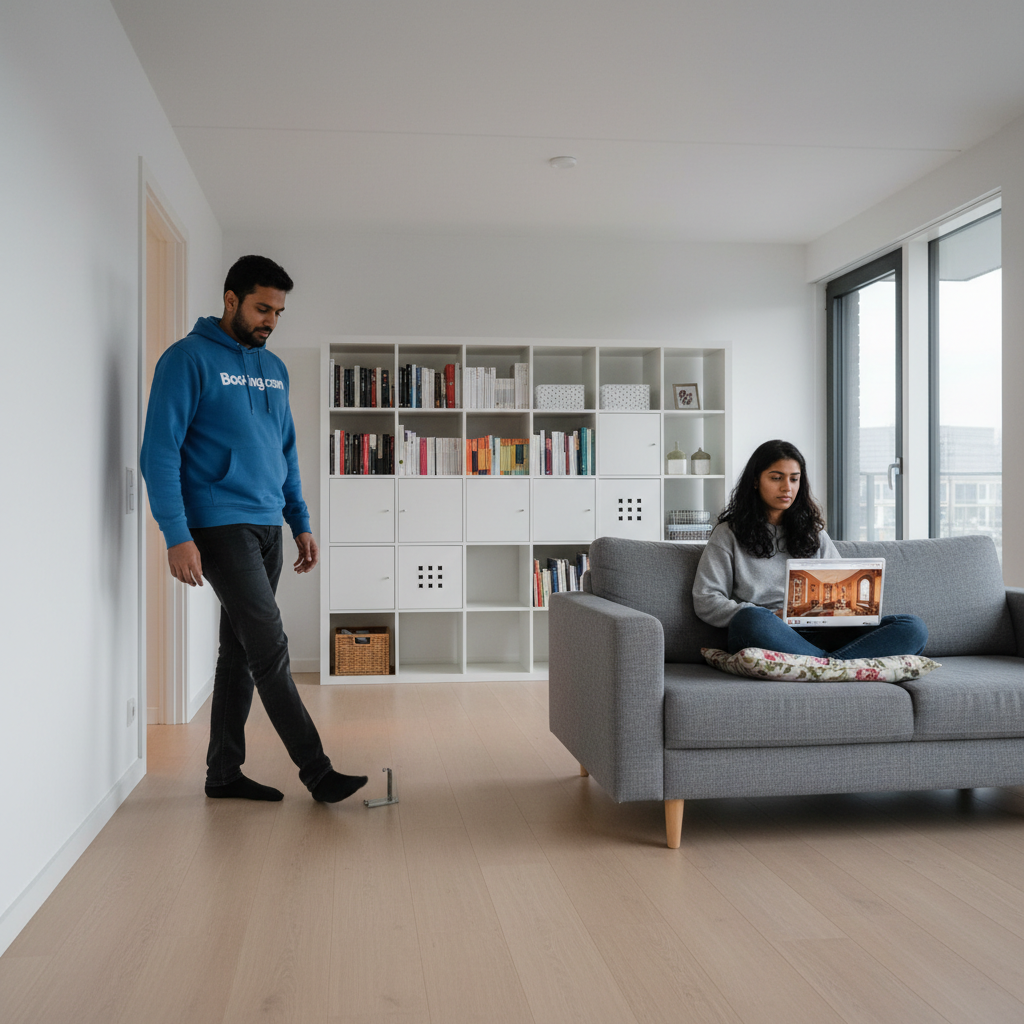
Opening scene
Demographics
Arjun, 29, and Meera, 27, are both from upper-middle-class Brahmin families in Bangalore. Arjun holds a BTech from BITS Pilani and works as a backend software developer at Booking.com's Amsterdam office, earning around €52,000 gross annually. He is competent and quietly proud of the international move but privately wonders whether he is just a well-paid cog. Meera is completing a master's in Communication Science at VU Amsterdam on a student visa, contributing modest freelance UX research income of roughly €13,000 per year. They are Indian passport holders navigating the Dutch knowledge migrant system, which colours every administrative decision with mild bureaucratic anxiety. Their combined household income sits around €65,000 before tax.
Living situation
They rent a two-bedroom apartment of approximately 65 square metres in Holland Park, Diemen-Zuid — a newbuild block with floor-to-ceiling windows, underfloor heating, and the soulless uniformity of every unit looking identical from the corridor. The second bedroom is nominally Meera's study but doubles as a storage dump for suitcases and the rice cooker box her mother insisted they bring from India. Everything is IKEA: Kallax shelving units acting as room dividers, Malm bedroom set, LACK side tables, a Brimnes TV unit. The walls are regulation white and completely bare — partly because their tenancy agreement makes them nervous about drilling, partly because they have never found anything worth hanging. Decision-making is theoretically joint but Meera drives aesthetic choices whilst Arjun controls the budget spreadsheet.
Psychographics
Arjun scores high on conscientiousness and low on openness to experience — he likes systems, spreadsheets, and predictable outcomes. He processes decisions analytically, often to the point of paralysis: he spent three weeks comparing IKEA desks before buying the BEKANT. Meera is the inverse — high openness, moderate neuroticism, a visual thinker who absorbs Pinterest boards and Instagram interiors accounts but lacks the confidence to translate inspiration into action in a country where she does not yet feel she belongs. Their shared emotional baseline is restlessness: a low-grade dissatisfaction neither has fully named. They value family deeply, call Bangalore on WhatsApp video every Sunday, and feel guilty that their flat looks nothing like the warm, layered homes they grew up in. Meera privately fears that the genericness of their apartment reflects something temporary about their life here.
Behavioural patterns
They are digital-first in almost every domain. Arjun researches purchases obsessively on Reddit, Tweakers.net, and YouTube review channels before buying anything over €50, often abandoning carts when he cannot optimise further. Meera discovers products and services through Instagram, saves posts compulsively, and rarely acts on them — her saved folder is a graveyard of aspirational living she has not pursued. They order groceries through Picnic, default to Bol.com for household items, and have a shared Google Keep list that functions as their household brain. Physical post goes directly into the paper recycling bin by the front door — Arjun installed the bin there specifically to intercept junk mail. QR codes, however, they scan reflexively; Arjun even pays at the Albert Heijn with his phone. They visit IKEA Zuidoost roughly every two months, always on a Saturday, always eating meatballs, always buying something unplanned from the marketplace section. They have never set foot in an independent interiors shop in the Netherlands. Their evenings follow a pattern: Arjun codes or games, Meera studies or scrolls, they eat together watching something on Netflix, and the flat remains exactly as it was.
Contextual influences
They are eighteen months into expat life — past the honeymoon phase, deep in the 'is this really it?' adjustment valley. Meera's thesis deadline in four months creates a background hum of academic stress that makes any non-essential decision feel like an indulgence. Arjun's team at Booking.com recently went through restructuring, which sharpened his instinct to save rather than spend. Their social circle is almost entirely other Indian expats from Arjun's office and Meera's university cohort — they socialise over home-cooked biryani in each other's identical Holland Park apartments, quietly noticing who has managed to make their place feel more like home. Meera's mother, on every video call, comments on the bare walls, which lands somewhere between concern and criticism. Dutch housing culture — the expectation that you might move when your contract ends, the reluctance of landlords to permit modifications — reinforces their sense of impermanence. They have not yet decided whether the Netherlands is a five-year plan or a permanent home, and this unresolved question bleeds into every spending decision above grocery level.
Response patterns & biases
In an interview setting, Arjun defaults to analytical mode — he will ask about pricing structures, compare value propositions, and express scepticism through quiet questions rather than outright dismissal. He under-reports emotional needs and over-emphasises rational justification. Meera is more forthcoming about feelings but hedges with qualifiers: 'I think maybe,' 'it's not a big deal but.' She exhibits social desirability bias around appearing financially responsible, a cultural imprint from her upbringing. As a couple, they perform a subtle negotiation in real time — Arjun will raise a practical objection, Meera will counter with an emotional argument, and neither will commit until the other signals approval. They are likely to express interest tentatively, circle back to price, and ultimately defer any decision to 'we'll think about it and discuss later.' Their attention span for marketing material is approximately three seconds unless a visual or price point hooks them immediately.
Pain points
Brand relationships
IKEA is their entire reference frame for home furnishing — trusted, affordable, familiar, but increasingly associated with settling rather than choosing. They are not brand-conscious in the aspirational sense; they are brand-dependent in the practical sense. Arjun trusts brands with transparent pricing and clear value propositions. Meera is drawn to brands with visual warmth and storytelling but has no loyalty to any interiors brand beyond IKEA because she simply has not encountered alternatives in her Dutch life. They would respond well to a brand that feels accessible, honest about cost, and explicitly welcoming to people who rent.
Daily life
Arjun cycles to Diemen-Zuid metro station at 08:15, rides to Amsterdam Amstel, and is at his desk by 09:00. Meera studies from the BEKANT desk in the second bedroom until her eyes blur, then moves to the sofa. They reconvene around 19:00, cook dal or order from Thuisbezorgd, and eat on the sofa because their small dining table is perpetually covered in Meera's research papers. The flat is warm, quiet, and functional. It is also, Meera thinks as she looks at the bare white wall above the television for the hundredth time, completely forgettable.
Backstory
Arjun and Meera married in Bangalore in 2024 — a large family wedding, every detail curated by their mothers — and moved to the Netherlands three months later when Arjun's Booking.com contract came through. The transition was exhilarating and disorienting in equal measure. They furnished the apartment in a single frantic IKEA trip their first weekend, treating it as a temporary setup they would upgrade 'once we're settled.' Eighteen months on, nothing has been upgraded. The temporary became permanent through inertia, and the flat that was supposed to be a starting point now feels like it might be the whole story. Meera sometimes opens Houzz or Pinterest late at night, saving rooms that look like the one she grew up in — layered, colourful, alive — then closes the app because she does not know where to start and is not sure they can afford to.
For Arjun and Meera, their apartment's blankness is not a decorating problem — it is an identity question. They are caught between cultures, between temporary and permanent, between what they can afford and what would make this place feel like theirs. Any service that reaches them must first convince them it is meant for people exactly like them: renters, expats, mid-budget, unsure where to start.