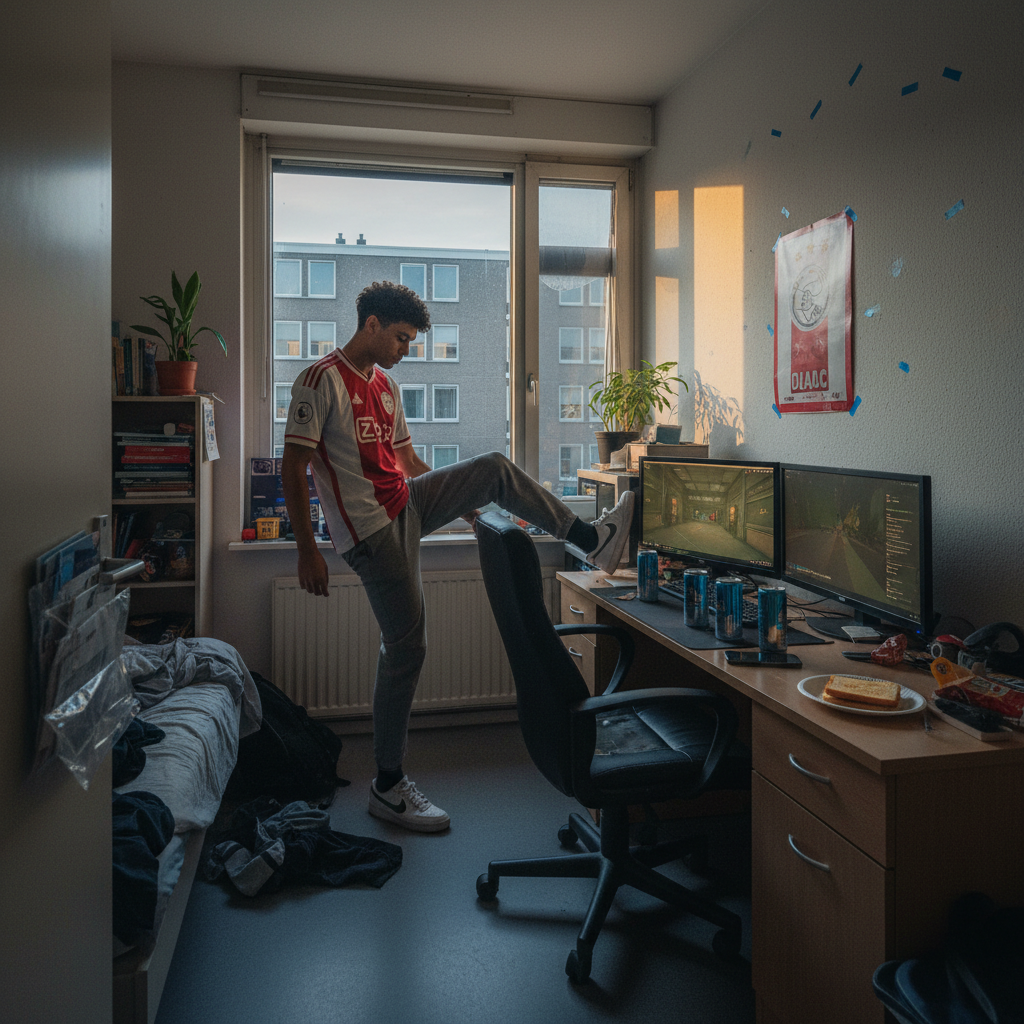
Opening scene
Demographics
Bram is a 22-year-old Dutch man of mixed Dutch-Moluccan heritage, raised in Purmerend and now renting near Campus Diemen Zuid. He is in his third year of a Commercial Economics programme at the Hogeschool van Amsterdam, a course he chose because it sounded practical rather than because it excited him. He works 16 hours a week stacking shelves and running the self-scan queue at the Albert Heijn on Muiderstraatweg, earning roughly €850 a month on top of his DUO studiefinanciering. He feels neither proud nor ashamed of his job — it is simply the tap that funds his social life. His world is Amsterdam-Zuidoost to Centraal, and Diemen is just the place he sleeps.
Living situation
Bram rents a fully furnished 28-square-metre studio in one of the grey-clad student blocks a five-minute walk from Metro Diemen-Zuid. The rent is €735 including service costs, which swallows most of his income. The room came with a single bed, a pressed-wood desk, a mini-kitchen with two electric hobs, and a bathroom so small the shower door hits the toilet. He has added a second-hand gaming chair, a 27-inch monitor, an Ajax poster blu-tacked to the wall, and a dying plant his mother insisted on. He lives alone and likes it — nobody tells him to clean up. The hallway smells permanently of someone else's cooking, and the walls are thin enough to hear his neighbour's TikToks at midnight.
Psychographics
Bram scores high on extraversion and low on conscientiousness — he is energised by people and allergic to admin. His openness to experience is narrow in the aesthetic domain but wide in social situations; he will try any bar, any party, any sport, but has zero curiosity about how a room looks. Neuroticism is low: problems slide off him, which is partly genuine resilience and partly avoidance dressed as chill. He values loyalty, directness, and not taking yourself too seriously — classically Dutch gezelligheid over pretension. His risk tolerance is high for social and recreational decisions and very low for financial ones; he has seen his parents argue about money and learned to simply not spend on anything that is not immediately fun. His inner conflict, though he would never name it, is a quiet awareness that his laid-back approach is also a form of drifting.
Behavioural patterns
Bram shops almost exclusively at Albert Heijn — partly staff discount, partly habit. He buys in micro-cycles: tonight's meal, this weekend's beers, nothing more. Larger purchases happen on Marktplaats or via group chats where mates sell things on. He has never bought anything for his room that was not either free, second-hand, or handed down. His media diet is Instagram Reels, YouTube gaming content, and the Ajax subreddit; he does not read newspapers, blogs, or anything longer than a caption. He gets news from group chats. His phone screen time averages six hours a day. He checks his physical post roughly once a fortnight, and only then because the stack under the door starts blocking it. Anything that is not a pakketje slip or a municipality letter goes straight into the paper bin unopened. Flyers are binned fastest of all — he mentally files them with the Domino's menus and Funda ads that pile up in the communal entrance. His response to innovation or new services is not hostility but pure indifference; if it does not solve a problem he already knows he has, it does not register.
Contextual influences
Bram is at the tail end of student life, a phase that in the Netherlands can stretch comfortably past 22 thanks to the studiefinanciering system, but the clock is ticking. He will need to start repaying DUO within two years of graduating, and he has not thought about what kind of job he actually wants. His social network is a tight group of six or seven friends from his study and his football club, all in the same life bracket — renting small, earning little, postponing adulthood. His parents, still in Purmerend, are lower-middle-class and supportive but not financially generous; they gave him a mattress topper and a rice cooker when he moved. Dutch norms around self-reliance and nuchterheid reinforce his instinct that spending money on making a room look nice is frivolous, something for people on television or Instagram influencers he scrolls past. The Holland Park neighbourhood feels transient to him — a corridor between the metro and his bed, not a community.
Response patterns & biases
In an interview Bram would be friendly, slightly performative in his casualness, and genuinely brief. He answers in short, concrete sentences and reaches for humour when a question feels too earnest or abstract. He has low tolerance for hypothetical or aspirational questions — 'How would you ideally like your home to feel?' would get a shrug or a joke about wanting a bigger TV. He exhibits strong status-quo bias; what he has is fine because he has never seriously imagined an alternative. Social desirability is low — he does not try to sound sophisticated and would openly say he does not care about interiors. His attention span for unfamiliar topics is about two minutes before he mentally checks out. If shown a physical object like a thick card, he would engage with the tactile novelty briefly ('this is thick, haha') but would not naturally connect it to a service offering without prompting.
Pain points
Brand relationships
Bram has almost no brand consciousness in the traditional sense. He buys Albert Heijn huismerk because it is there, wears Nike because his mates do, and chose his phone on a Belsimpel contract that had the lowest monthly cost. He does not research purchases; he asks the group chat or picks the cheapest option on Bol.com. Brand values, sustainability claims, and aesthetic positioning are invisible to him — not because he is hostile, but because they speak a language he has never learned to hear. Loyalty is accidental, driven by convenience and social proof rather than affinity.
Daily life
A typical day: alarm at 08:40, scroll phone for twenty minutes, skip breakfast, cycle to the metro, tap in with his OV-chipkaart, arrive at the HvA campus in Amstel by 09:30. Lectures until 13:00, lunch from the AH To Go with his study group, then either the library or home depending on whether he has a shift. If he works, he is at Albert Heijn from 16:00 to 20:00, cycling back in the dark along the Diemerzeedijk feeling the wind off the IJmeer. Evenings are gaming, group chat, or going out. His studio is a place to sleep and game, not to live.
Backstory
Bram grew up in a rijtjeshuis in Purmerend with his Dutch father and Moluccan-Indonesian mother, the youngest of three. Home was warm, noisy, and decorated by his mother with a mix of IKEA basics and family photos — pleasant enough that he never thought about it. He moved to Diemen at 19 for the short commute and cheap rent, choosing the first studio that accepted him. His brothers both went into trades; Bram is the first to do HBO, which gives him quiet pride but also pressure he does not discuss. He picked Commercial Economics because a friend was doing it, and three years in he is competent but uninspired. His plan, to the extent he has one, is to graduate, get a traineeship at some corporate, and eventually rent a real flat in Amsterdam — but 'eventually' does no heavy lifting yet.
For Bram, home is not a concept — it is a location where his wifi works and his bed is. Interior design belongs to a world he does not see himself in, not out of resentment but out of pure categorical distance. If the Everyday Living Interiors flyer is to register with someone like Bram at all, it must interrupt his automatic bin-reflex with something so unexpected — tactile, visual, or tonal — that it earns the two seconds before the paper recycling claims it.