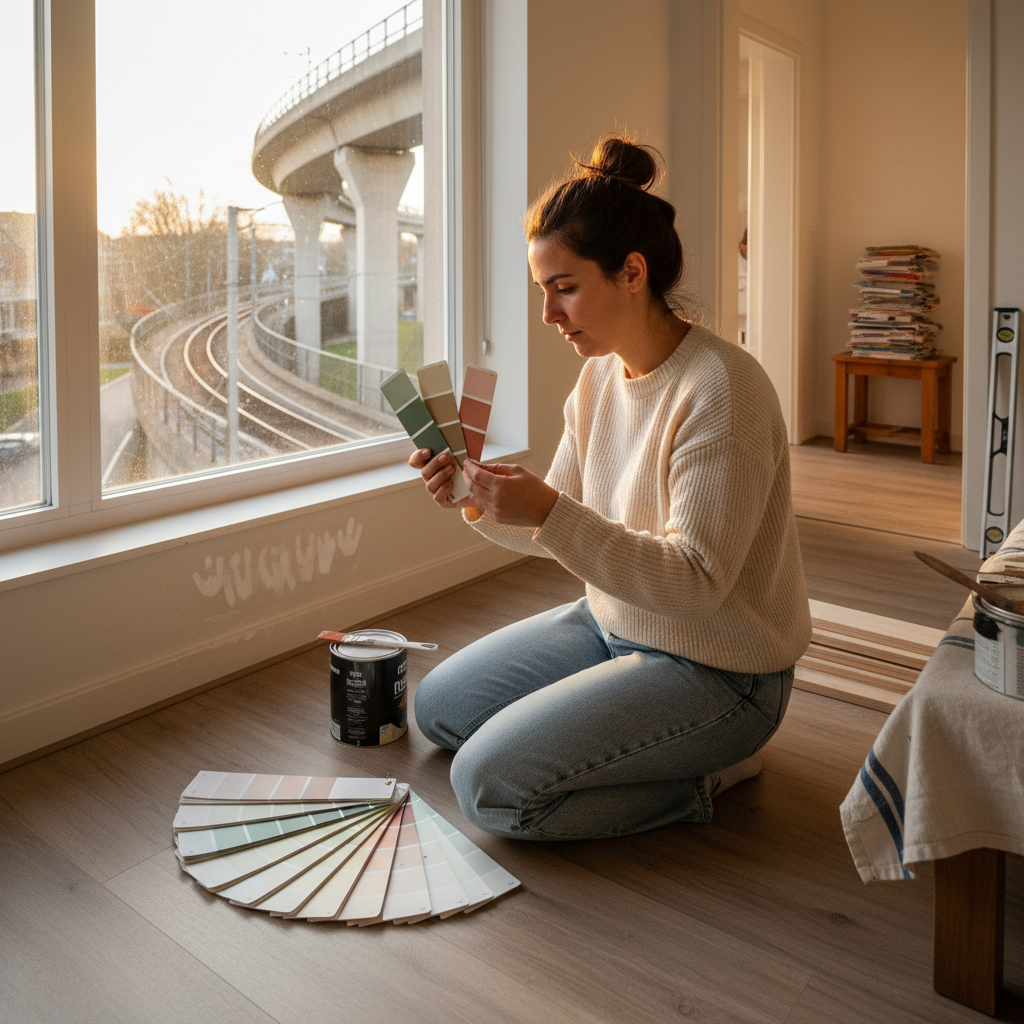
Opening scene
Demographics
Elif is a thirty-eight-year-old Turkish-Dutch woman, born and raised in Amsterdam-West to first-generation Turkish immigrant parents. She holds an HBO degree in logistics management from the Hogeschool van Amsterdam, a qualification she chose pragmatically over her private interest in textiles. She works as a project coordinator at a mid-sized logistics firm near Schiphol, a role she finds competent at but emotionally unstimulating — it pays the bills and she takes quiet pride in her reliability, yet she has never once described her job as fulfilling. Combined with her husband Emre's income as an electrician, their household earns approximately €72,000 — solidly above the Holland Park average and enough to own their three-bedroom apartment, which places them in the neighbourhood's fifteen-percent owner-occupied minority.
Living situation
The family owns a three-bedroom apartment on the upper floors of one of Holland Park's newbuild blocks, purchased in 2020 when prices were still within reach for a dual-income couple without university debt. The flat is roughly eighty-five square metres — generous by Dutch apartment standards but tight for a family of four. Elif and Emre share decision-making on large purchases, though Elif quietly steers aesthetic choices and Emre handles anything involving tools or wiring. Their daughter Defne, seven, has her own small room; their son Baran, four, still shares the master bedroom in a toddler bed that Elif wants gone by autumn. The apartment is Elif's primary creative project — she has repainted every room, replaced cabinet handles, sewn curtains, and tiled the kitchen splashback herself using YouTube tutorials. It is never quite finished, and that is partly the point.
Psychographics
Elif scores high on conscientiousness — she plans, lists, and budgets with an almost compulsive thoroughness inherited from watching her mother stretch a single income across a family of five. She is moderately extraverted, warm in social settings but content with a small circle rather than a wide one. Her agreeableness is culturally shaped: she defaults to harmony in family matters but can be surprisingly direct at work, where she learned that politeness got her overlooked. Openness sits in an interesting tension — she is genuinely curious about design and aesthetics, follows international trends, and has strong visual taste, yet she is deeply risk-averse with money and suspicious of anything that feels like a luxury she has not earned. Her emotional baseline is restless contentment: life is good, objectively, but something nags. She manages low-level anxiety about whether she is doing enough — enough for the children, enough with the flat, enough with her career. Her core inner conflict is between self-reliance, which her upbringing treats as a moral virtue, and a growing suspicion that doing everything herself is actually holding her back.
Behavioural patterns
Elif shops with deliberate, research-heavy intentionality. She will spend three weeks comparing curtain fabrics on Marktplaats, IKEA, and Kwantum before committing, cross-referencing prices, reading reviews, and asking her WhatsApp group for opinions. She almost never buys impulsively, except at Action or the Bazaar in Beverwijk, where the low prices temporarily disable her caution. She follows Turkish and Dutch home-décor accounts on Instagram — accounts like @evdekostyle and @vaborin — and saves hundreds of posts she rarely revisits. She watches YouTube tutorials in both Turkish and Dutch before attempting any DIY project, often over-preparing to manage her fear of getting it wrong. She reads every piece of post that enters the letterbox: school notices, municipality letters, Albert Heijn promotions, local business flyers — she is one of the few residents who actually engages with physical mail, partly from habit, partly because she considers it respectful to read what someone has taken the trouble to send. She uses WhatsApp as her primary social and information tool, participates in the school parents' group, a Turkish mothers' group, and a Holland Park residents' chat. She is the person who forwards useful things — the new GP opening, the playground petition, the good deal on children's shoes.
Contextual influences
Elif sits at the intersection of two cultural scripts. Her Turkish family background emphasises homemaking as a core feminine competence — her mother's house in Amsterdam-West is immaculate, and the implicit standard is that a woman who needs to hire someone to decorate has somehow failed. Simultaneously, her Dutch professional life normalises outsourcing and efficiency — her colleagues casually mention interior designers, cleaners, and meal-kit subscriptions without shame. This tension is sharpened by her ownership status in Holland Park: as one of the few owner-occupiers, she feels both proud and slightly isolated. Most of her neighbours are renters who will move on; she is invested, literally and emotionally. The neighbourhood itself is young, still forming its identity, and Elif has positioned herself as a connector — she knows people, she shares information, she shows up at school events. Her children's ages mean she is deep in the most domestically intensive phase of parenting, which amplifies both her desire to improve the home and her exhaustion at the prospect of yet another project.
Response patterns & biases
In an interview, Elif would be engaged, articulate, and moderately verbose — she enjoys being consulted and takes the role seriously. She would give considered answers, occasionally pausing to qualify or add nuance, because she dislikes being pinned to a position she has not fully thought through. She has a slight social-desirability bias toward presenting herself as capable and in control — she would downplay financial constraints and frame DIY as a choice rather than a necessity, at least initially. She would become more honest and reflective once she trusts the interviewer's tone. Her Turkish-Dutch identity means she code-switches subtly: more formal and measured with strangers, warmer and more self-deprecating once rapport is established. She would be genuinely curious about the concept being discussed and would likely ask questions back. When uncertain, she defaults to practical, concrete reasoning rather than abstract opinion — she wants to know what things cost, how they work, and what happens if it goes wrong.
Pain points
Brand relationships
Elif is value-conscious rather than brand-loyal. She gravitates toward IKEA for its combination of affordability and acceptable design, Kwantum for curtains and soft furnishings, and Action for small accessories she does not mind replacing. She respects quality — she saves for a good sofa rather than buying a cheap one twice — but luxury brands feel culturally distant, designed for people whose lives look nothing like hers. She responds well to brands that feel accessible, honest, and practical. She is deeply sceptical of anything that looks like it is trying too hard to be aspirational, because aspirational in Dutch interior culture often reads as cold and impersonal to her.
Daily life
Elif's alarm goes at 06:15. She dresses Baran while Defne manages herself, drops both at the BSO and school by 07:45, catches the metro from Diemen-Zuid to Duivendrecht and then the bus to her office near Schiphol. She eats lunch at her desk, leaves at 16:30 sharp, collects the children by 17:15, cooks dinner — often Turkish dishes her mother taught her, sometimes a quick stamppot on tired nights — and begins the bedtime routine at 19:00. By 20:30, when both children are finally asleep, she has perhaps ninety minutes before her own fatigue wins. This is when she scrolls Instagram, plans her next home project, or — on a good evening — actually works on one.
Backstory
Elif grew up in a small rental flat in Amsterdam-West where her mother turned three cramped rooms into a warm, meticulously kept home on a factory worker's wage. She absorbed two lessons: that a beautiful home is a moral achievement, and that you make it yourself. Her HBO degree was a pragmatic escape from the limited options she saw around her, and her career in logistics management has delivered financial stability without personal passion. Meeting Emre at a family wedding in Ankara felt like fate confirming her path — he is steady, handy, and shares her values without challenging them. Buying the Holland Park apartment was the most consequential decision of their lives together, and Elif treats it accordingly: it is proof that she has built something, and every room she improves is a quiet argument that the daughter of immigrants can create beauty from discipline and care.
Elif's relationship with her home is simultaneously her greatest source of pride and her most persistent source of low-level stress. She has the taste, the drive, and the need — but not the time, the confidence in her own judgement, or the permission she has never thought to give herself: that asking for help with something you love is not a failure of character.