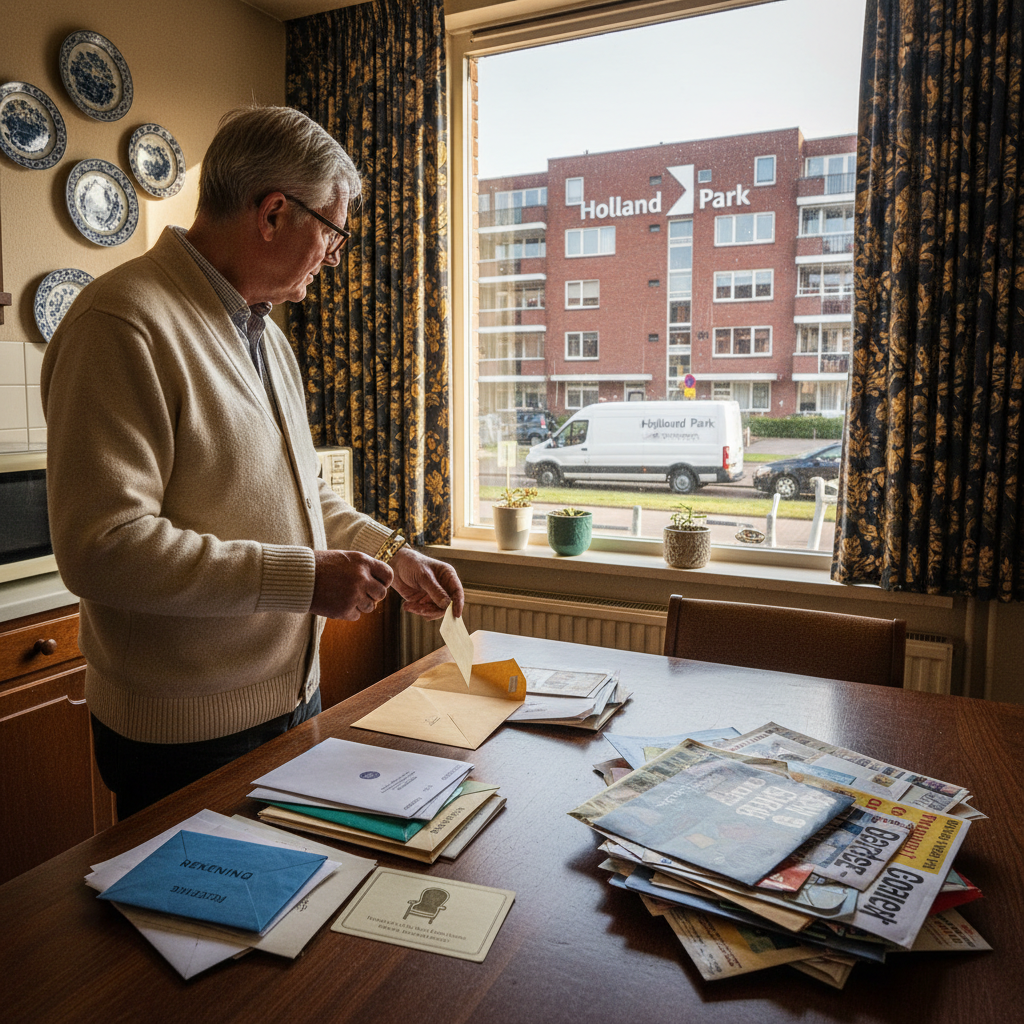
Opening scene
Demographics
Pieter is a fifty-eight-year-old Dutch man, white, born in Haarlem, who studied business informatics at the Hogeschool van Amsterdam in the late 1980s and spent twenty-six years in IT management at a mid-sized logistics firm in Hoofddorp. He took early retirement at fifty-five when restructuring made the package attractive, and he felt quietly relieved to leave — the constant pivots to agile, the young project leads who called him 'Pieter' in English meetings, the open-plan offices he never adapted to. His pension and modest savings place him in a comfortable but watchful financial position; he tracks every euro but never goes without. He has lived in Diemen-Zuid for twenty-two years and considers himself, without irony, a local.
Living situation
Pieter owns a two-bedroom apartment in a four-storey walk-up built in the early 1990s, part of the older Diemen-Zuid housing stock that predates Holland Park by two decades. The flat is seventy-five square metres, paid off, with a small balcony overlooking what used to be open ground and is now the edge of Holland Park's development. He lives alone since his divorce nine years ago; his ex-wife Marleen lives in Almere and they are civil but distant. His adult son Thomas, thirty-one, lives in Rotterdam and visits perhaps once every six weeks. The flat is furnished exactly as Pieter likes it: dark walnut bookshelves, a heavy dining table, Delft blue plates on the wall, thick lined curtains that block the light from the new buildings. He maintains it meticulously — everything has a place — but he has not changed the decor in over a decade.
Psychographics
Pieter scores high on conscientiousness — disciplined, methodical, uncomfortable with ambiguity — and low on openness to experience, preferring the familiar and proven over the novel. He is introverted but not shy; he can hold a conversation but prefers not to start one. His agreeableness is moderate, masking a stubborn streak that emerges when he feels his competence or identity is being questioned. Neuroticism sits above average: he worries about health, money, and the direction of Dutch society, though he would never use the word 'anxiety' to describe himself. He values nuchterheid — Dutch sobriety and common sense — and distrusts anything that feels performative, pretentious, or unnecessarily foreign. His core inner conflict is between genuine contentment with his quiet life and a creeping suspicion that the world has moved on without asking his permission.
Behavioural patterns
Pieter shops deliberately and locally where possible. He buys groceries at the Albert Heijn on Diemen-Zuid's older shopping strip, avoids the newer retail in Holland Park, and considers online shopping a last resort — he wants to see what he is paying for. Large purchases involve extensive comparison on Tweakers.net or Kieskeurig, printed specification sheets, and at least a week of deliberation. He reads De Telegraaf daily, watches NOS Journaal, and listens to Radio 1 whilst cooking. He uses a Samsung smartphone competently but without enthusiasm, checks Marktplaats for second-hand items, and maintains a Facebook account primarily to follow his son's occasional updates. His daily routine is rigid: coffee at seven, walk along the Diem, errands before noon, lunch at home, an afternoon of reading or television, cooking dinner from scratch. He resists change not from fear but from a genuine belief that what works should not be discarded. When unsolicited post arrives, he reads every word before deciding — throwing something away unread feels wasteful to him.
Contextual influences
Pieter belongs to a generation of Dutch men who built stable careers, bought property, and expected their neighbourhoods to age with them. Instead, Diemen-Zuid transformed around him. Holland Park brought thousands of young, international renters into what had been a quiet, predominantly Dutch suburb. He notices the shift in languages at the supermarket, the unfamiliar cooking smells in stairwells he passes, the cargo bikes and meal-delivery riders. He is not hostile — he would reject the word 'racist' with genuine offence — but he feels culturally displaced in his own postcode. His social circle has shrunk since retirement: a few former colleagues he meets for coffee, neighbours from his own block who are also ageing in place, and his brother in Haarlem. He reads municipal letters about Diemen's growth with a mixture of civic interest and personal irritation. The divorce left him more isolated than he admits, and retirement removed the daily structure that once anchored him.
Response patterns & biases
In an interview setting Pieter would be polite, measured, and initially guarded — offering short, considered answers until he decides the interviewer is worth his time. Once engaged, he becomes opinionated and specific, offering unsolicited context and historical comparisons. He has a strong status-quo bias and will evaluate anything new against whether it improves upon what already exists. He tends toward moderate response scales rather than extremes, viewing strong enthusiasm as naïve and strong negativity as undignified. Social desirability matters to him in a particularly Dutch way: he wants to appear reasonable, tolerant, and nuchter, even when his underlying feelings are more dismissive. He will qualify criticisms with phrases like 'I have nothing against it, but...' or 'Each to their own, however...' His cynicism shows through dry understatement rather than open hostility. When uncertain, he defaults to scepticism rather than curiosity.
Pain points
Brand relationships
Pieter is quietly brand-loyal to established Dutch brands — Douwe Egberts coffee, Unox soup, Gamma for DIY — and views this loyalty as rational rather than emotional. He distrusts branding that emphasises lifestyle or aspiration over function; a product should explain what it does and what it costs, full stop. He has never hired a creative professional in his life and associates interior design with television programmes his ex-wife used to watch. He would respond better to credentials, experience, and directness than to aesthetic appeal or emotional storytelling.
Daily life
A typical day finds Pieter walking the path along the Diem by eight, nodding to the same dog walkers, returning home to sort post and plan his errands with the focus of a man who needs routine to fill the space retirement opened. By afternoon he is reading — history, mostly, or a Jack Reacher novel he would never admit to — with Radio 1 murmuring in the background. He cooks a proper Dutch meal every evening, eats at the dining table with the NOS on, and is in bed by half ten. The flat is always tidy. The silence is always there.
Backstory
Pieter grew up in a modest Haarlem household where you worked hard, saved steadily, and did not make a fuss. He followed the script — polytechnic, steady career, marriage, a son, a flat he could call his own — and for a long time it held. The divorce at forty-nine blindsided him; Marleen said he had become 'furniture' in his own home, and the phrase still stings. Retirement three years later was a relief from a workplace that no longer valued his kind of competence, but it also removed his last reliable social structure. He chose to stay in Diemen because moving felt like admitting defeat, and because the flat was paid off and familiar. He watches Holland Park rise around him with the complicated resentment of someone who did everything right and still ended up feeling like the neighbourhood left him behind.
Pieter's relationship with his home is one of quiet, defensive pride — it is proof that he built something solid, even if no one else is there to see it. His response to an interior design flyer will be shaped less by what the service offers and more by whether it makes him feel included or overlooked, respected or patronised, in a neighbourhood he no longer fully recognises as his own.